

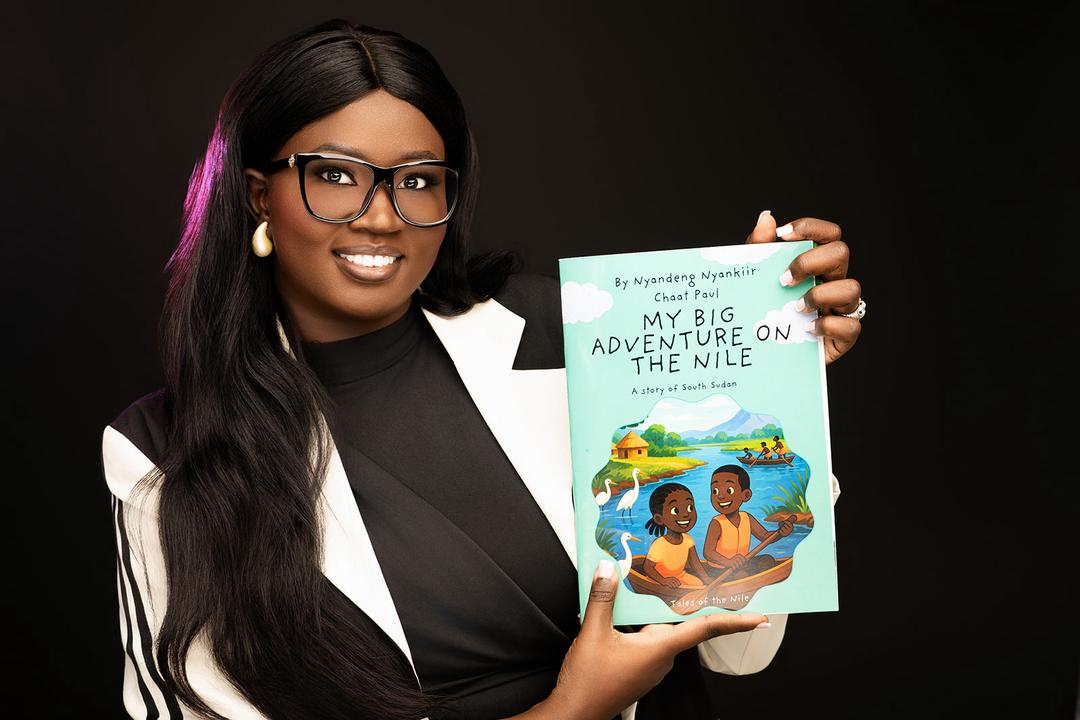
Nyandeng Chaat’s story begins in a home that chose a different path. As a young girl, Nyandeng says those words shaped how she saw herself and her future. While many girls in South Sudan around her age at the time were already being prepared for marriage, she learned early that her education mattered just as much as anyone else’s. That belief stayed with her through school and later influenced the work she chose to do as a communicator and children’s book author. For her, storytelling became more than a career. It became a way to reflect the experiences, hopes, and possibilities of young South Sudanese girls.
She grew up in a family of seven girls, all of whom went on to earn bachelor’s degrees. In the context of South Sudan, that is not a small achievement. For many girls, education is often cut short, shaped by expectations of early marriage and limited encouragement to continue school.
But Nyandeng’s story is different because her father made it different.
In a conversation on the Voices and Stories podcast with host Kafuki Jada, she shares how his mindset shaped their lives in a lasting way. While many families prepared their daughters for marriage, he chose to prepare his for education. His words were simple but firm, “Bring me a bachelor’s degree before you bring a husband.”
It was not just advice. It became a standard in their home. Education came first. Marriage could wait.
That kind of clarity gave Nyandeng and her sisters direction early in life. It allowed them to focus, to dream differently, and to see themselves beyond the limits often placed on girls around them. Today, Nyandeng is a communications specialist and a children’s book author, using her voice and creativity to tell stories that matter.
Her sisters have also carved their own paths in different fields. Some are in communication like her, others work in banking and across various sectors. Together, they reflect what is possible when girls are supported and given the space to grow.
Nyandeng’s story is not just about one family. It speaks to a bigger truth. That sometimes, all it takes is one decision at home to shift the future of many.
So what happens when more families begin to think this way?
What would change if more girls were told to choose education first?
According to international education and development reports, many girls in South Sudan still face major barriers to completing school, including poverty, conflict and early marriage. Female literacy rates remain among the lowest in the region, making stories like Nyandeng’s both inspiring and deeply important. They remind us what becomes possible when girls are given consistent support and encouragement to stay in school.
So perhaps the real question is not whether girls are capable of achieving more. The question is: how many more could thrive if they were supported from the very beginning?
Share your thoughts with us ……. what do you think comes first a husband or a degree ?